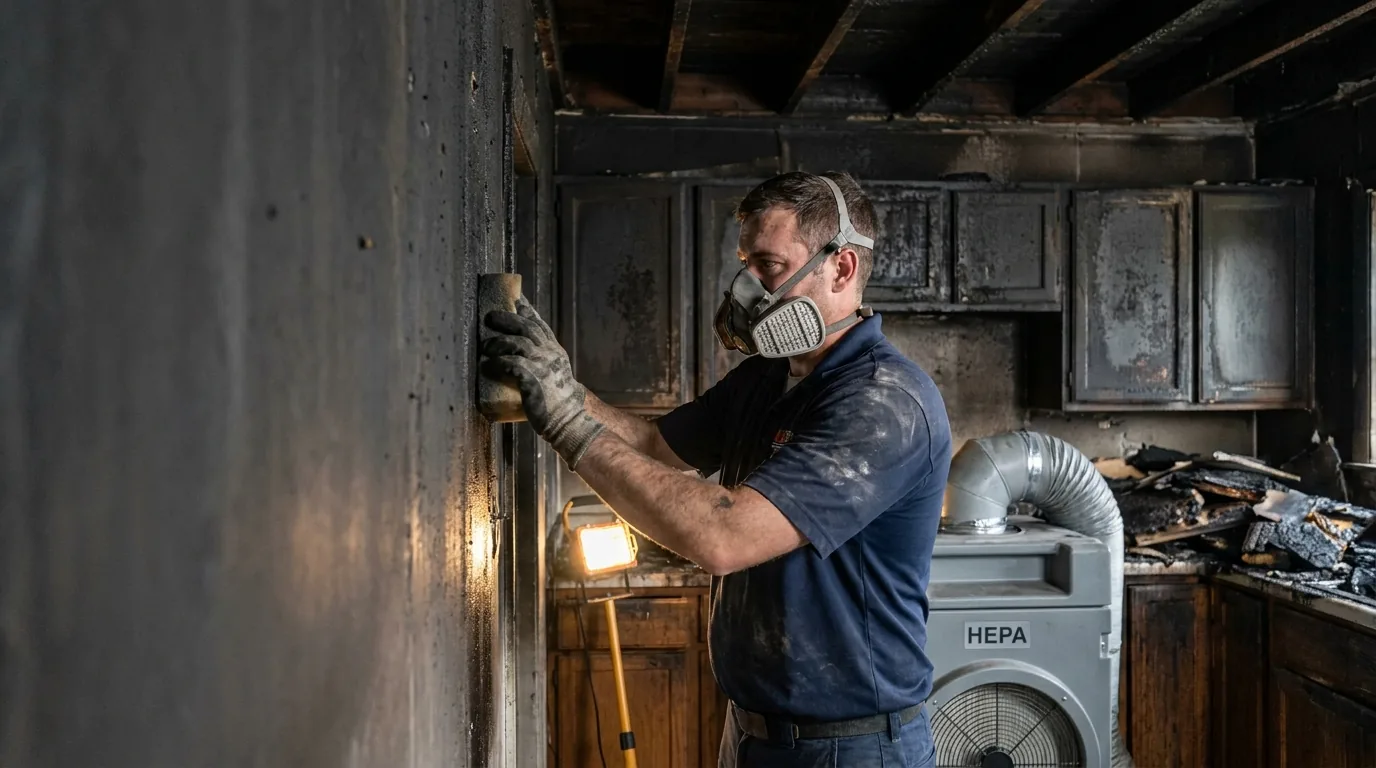
Fire Damage Restoration in Saratoga Springs
24/7 fire damage restoration in Saratoga Springs and surrounding areas. IICRC-certified, insurance billing accepted. Call (801) 995-2437.
The clock starts the moment flames are out
Smoke doesn’t stop moving when the fire does. Within hours of extinguishment, acidic soot begins etching chrome fixtures, yellowing painted walls, and embedding itself into porous materials — drywall, wood framing, upholstery, clothing. Within 72 hours, what was cleanable becomes permanently stained. The fire is over; the damage is still happening. That’s the problem fire and smoke restoration exists to solve, and it’s why the speed and sequence of the response matters as much as the equipment brought to the job.
What fire damage restoration actually involves
Fire cleanup is not a matter of wiping soot off surfaces and airing out a house. The work divides into three overlapping disciplines: structural assessment, smoke and soot remediation, and odor elimination — each requiring different chemistry, different equipment, and a different eye.
Structural fire damage ranges from charred framing that needs replacement to heat-compromised materials that look intact but have lost structural integrity. Before any cleaning begins, the building has to be safe to work in — utilities confirmed off or isolated, load-bearing elements evaluated, and any collapse risk documented.
Soot remediation depends entirely on what burned. A kitchen grease fire produces a wet, protein-based smoke that films onto surfaces and smells nothing like the acrid, dry soot from burning synthetic materials — plastics, insulation, upholstery foam. Protein soot is nearly invisible and extraordinarily difficult to remove; synthetic soot is thick, oily, and spreads aggressively through HVAC systems. Matching the cleaning chemistry to the soot type is one of the most consequential decisions in post-fire restoration.
Odor elimination is the final and often most underestimated phase. Thermal fogging and ozone treatment penetrate the same microscopic spaces that smoke reached — inside wall cavities, subflooring, ductwork — neutralizing odor molecules rather than masking them. Hydroxyl generators are used in occupied or sensitive environments where ozone isn’t safe to deploy.
A full residential fire damage repair engagement typically runs 5–14 days for cleaning and odor work alone, before any reconstruction begins.
Our process
1. Emergency stabilization and safety assessment Before a single sponge touches a wall, the structure is evaluated for safety. We document pre-existing conditions, identify which materials are salvageable, and establish containment zones to prevent cross-contamination of unaffected areas. Board-up and tarping happen here if the structure is open to weather.
2. Soot characterization Not all soot is the same. We identify whether residues are dry/powdery (wood or paper combustion), wet/oily (synthetic materials), or protein-based (cooking fires) — because each type requires a different cleaning agent and technique. Dry soot responds to dry chemical sponges and HEPA vacuuming before any wet cleaning; wet synthetic soot requires solvent-based degreasers. Using the wrong chemistry drives soot deeper into the substrate.
3. Contents pack-out and inventory Salvageable contents — furniture, clothing, electronics, documents — are inventoried, packed, and transported to our cleaning facility. This protects them during structural work and allows ultrasonic cleaning, ozone treatment, and deodorization in a controlled environment. Every item is photographed and logged for your insurance claim.
4. Structural cleaning and HVAC decontamination Walls, ceilings, and floors are cleaned in a top-down sequence using appropriate chemistry for the soot type present. HVAC systems receive special attention: smoke travels through ductwork and deposits throughout the system, meaning a house can re-contaminate itself every time the air handler runs. Duct cleaning and filter replacement are not optional steps.
5. Thermal fogging and ozone treatment Once surfaces are clean, odor neutralization begins. Thermal fogging disperses a deodorizing agent as a fine mist that follows the same pathways smoke used — into wall voids, subflooring gaps, and porous materials. Ozone treatment follows in unoccupied spaces, breaking down odor molecules at the molecular level. The combination addresses odor at the source rather than covering it.
What separates a good fire response from a bad one
The most common failure in fire damage repair is treating all soot the same. Crews that apply wet cleaning to dry soot, or use alkaline cleaners on protein residue, permanently set the stain they’re trying to remove. A second common failure is skipping or rushing the HVAC decontamination — homeowners who move back in report the smell returning within weeks because the air handler is redistributing residue every time it cycles.
Insurance adjusters look for a few specific things: a documented scope that distinguishes between salvageable and non-salvageable materials, photographic evidence of pre-cleaning conditions, a contents inventory with replacement values, and a clear line between cleaning costs and reconstruction costs. Adjusters are experienced at identifying scopes that lump everything together to obscure what was actually done. A detailed, itemized restoration report protects your claim.
IICRC-certified technicians are trained in the S700 Standard for Professional Fire and Smoke Damage Restoration — the industry benchmark that defines proper soot characterization, cleaning sequences, and documentation requirements. Home Pride Restoration and Cleaning holds IICRC certification and operates under Utah contractor license #RC-25-0737.
Seasonal and regional considerations
Utah’s dry climate and high-altitude winters create specific fire risk patterns. Wildfire smoke events — increasingly common along the Wasatch Front — deposit fine particulate matter throughout homes even when no interior fire occurs, requiring the same soot and odor protocols as a structural fire. During winter months, heating equipment fires (furnaces, wood stoves, space heaters) spike, and cold temperatures slow the off-gassing process, meaning odors that seem manageable in December can intensify when the house warms in spring. Fire damage that sits through a Utah winter without proper treatment is harder and more expensive to remediate in the thaw.
Service area
Home Pride Restoration and Cleaning is based in Saratoga Springs and serves communities throughout Utah County and the greater Wasatch Front — including Eagle Mountain, Lehi, American Fork, Pleasant Grove, Orem, and surrounding areas. City-specific fire damage restoration pages link back here for full process detail.
Frequently Asked Questions
What's the difference between protein soot and synthetic soot, and why does it change how cleanup is done?
Why does smoke odor sometimes come back weeks after a fire was "cleaned"?
What should I do — and not do — while waiting for the restoration crew to arrive after a fire?
How does a contents pack-out work, and which items are typically salvageable?
Does wildfire smoke outside require the same remediation as an interior fire?

Need Fire Damage Restoration now?
We respond 24/7 across Saratoga Springs and surrounding UT cities.
Call (801) 995-2437Related Coverage
- Our Restoration Services
- Contact Home Pride Restoration and Cleaning
- Fire Damage Restoration in American Fork
- Fire Damage Restoration in Eagle Mountain
- Fire Damage Restoration in Herriman
- Fire Damage Restoration in Lehi
- Fire Damage Restoration in Orem
- Fire Damage Restoration in Pleasant Grove
- Fire Damage Restoration in Provo
- Fire Damage Restoration in Riverton
- Fire Damage Restoration in Saratoga Springs
- Fire Damage Restoration in South Jordan
- How To Choose a Restoration Company in (Without Getting Burned)
- The Fire Damage Restoration Process, Explained
- How Professionals Remove Smoke Odor (and Why DIY Usually Fails)